Drugs of abuse testing involves the analysis of a biological specimen, typically urine, saliva, blood, hair or sweat – to detect the presence of illegal drugs, misused prescription medication, or the metabolites of the aforementioned. It is one of the most widespread methods in medicine, work safety, sports, legal cases, and substance use treatment, so learning how a drug test works will help you understand the results no matter whether you are an employer, a patient or just a curious person. Although drug testing is very common, many people lack proper understanding of the test itself, its capabilities and reasons for false positives or negatives. Let us figure out together how a drug test works, what is it good for and when results may be incorrect.
What Is Drugs of Abuse Testing?
In a nutshell, drug testing involves checking the biological specimen for a specific drug or its metabolites produced by the body as a consequence of the drug metabolism. A positive test means that a certain substance or its metabolites were present in the specimen at the time of testing. It is crucial to know what a drug test can and cannot prove: on its own, a test can confirm the presence of a particular substance during the certain period of time, but not impairment, nor diagnosis of addiction or other substance use disorders. Clinical diagnosis is needed for that.
Drug testing is conducted in various spheres:
- Pre-employment and workplace screening – for instance, some companies demand from potential employees to pass a drug test prior to hiring or conduct random or reasonable suspicion, post-accident, or return-to-duty tests;
- Clinical and hospital settings – drug testing helps in diagnosing an overdose, treating the condition or monitoring a patient under treatment of controlled medications like opioids;
- Substance use treatment and recovery programs – to facilitate the monitoring and ensure accountability; Sports and athletics – to follow anti-doping rules;
- Legal and forensic cases, including probation, parole, custody proceedings, etc.;
- Pain management programs – to make sure that patients use prescribed substances properly and do not divert them.
Which Drugs Do Standard Drug Tests Screen For?
Standard drug panels vary by purpose, but most are built around a core group of substances. A basic “5-panel” test typically screens for:
- Amphetamines (including methamphetamine)
- Cannabinoids (THC, the psychoactive component of cannabis)
- Cocaine
- Opiates/opioids (including heroin, morphine, and codeine)
- Phencyclidine (PCP)
Expanded panels, such as 10-panel tests, add substances like benzodiazepines, barbiturates, methadone, propoxyphene, and MDMA (ecstasy). Many labs and clinics can also test for synthetic opioids like fentanyl, as well as alcohol, though alcohol is more often measured separately using breath testing because it clears the body quickly.
Drug Testing Methods: Urine, Blood, Saliva, Hair, and Sweat
Different biological samples offer different advantages depending on what question the test needs to answer, whether that’s recent use, chronic use, or use over the past several months. While urine remains the most common body fluid used for drug testing, alternative matrices such as blood, sweat, oral fluid, and hair have become increasingly common over the last several decades.
Urine Testing (Urinalysis)
Urine is by far the most widely used sample type for drugs of abuse testing. A urine sample of roughly 30-45 mL is collected and examined for drug metabolites, and it is generally recommended for checking illicit and prescription drug misuse because alcohol clears the system much faster than it can be reliably detected in urine. Urine testing strikes a practical balance between cost, ease of collection, and a detection window that typically spans a few days to a few weeks depending on the substance.
Blood Testing
Blood testing is less common than urine testing because it is more invasive, but it offers a key advantage: it reflects what is actively circulating in the bloodstream at the moment of collection, making it useful for confirming current impairment, such as in cases of suspected driving under the influence or medical emergencies. Its detection window is generally much shorter than urine or hair, often just hours to a couple of days.
Oral Fluid (Saliva) Testing
A saliva sample is collected with a swab of the inner cheek. This method is especially useful for determining current or very recent drug use, and it often performs better than urine at detecting recent marijuana, cocaine, and amphetamine use. Because saliva testing reflects a shorter window, it is popular for roadside and workplace testing where recent impairment is the concern, though for alcohol specifically, saliva correlates closely with blood concentration around two hours after consumption, though contamination of the oral cavity from certain drug routes of administration can distort the correlation for other substances.
Hair Testing
Hair testing offers a much longer detection window than urine or blood testing, potentially spanning months to years depending on the length of the hair sample, compared to hours to a few days for urine or blood. A standard hair sample collection typically involves cutting roughly 100 to 120 strands close to the scalp. Because hair grows at a fairly predictable rate, segmental analysis of the hair shaft, cutting it into roughly one-centimeter sections, can even offer a rough month-by-month picture of drug exposure over time. The tradeoff is that hair testing cannot detect very recent use, since it takes time for drug metabolites to become incorporated into new hair growth near the scalp. It also does not test for alcohol use.
Sweat Testing
Sweat testing uses a patch worn on the skin, similar to a large adhesive bandage, over an extended period to collect sweat continuously. This approach is a relatively simple method, but it is mainly used in parole or rehabilitation monitoring rather than typical workplace testing. It offers a way to monitor drug use continuously over days or weeks without repeated sample collection.
How Drug Testing Labs Analyze Samples
Regardless of which sample type is collected, laboratories generally use a two-step approach to balance speed, cost, and accuracy.
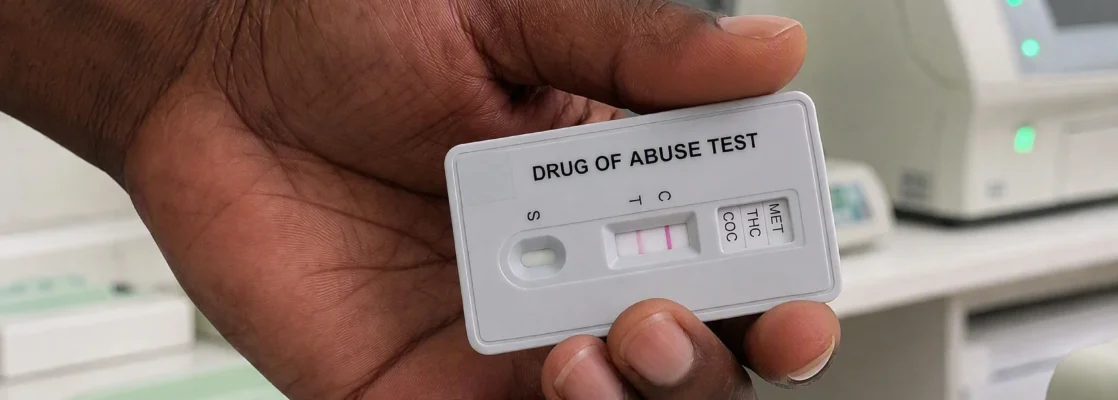
Step 1: Initial screening. The most commonly used screening methods are immunoassay and chromatography techniques, which vary in their sensitivity, specificity, turnaround time, and cost. Immunoassay tests are fast and inexpensive, using antibodies that bind to a drug or its metabolites to produce a visible reaction. These are the same basic technology behind rapid point-of-care test cups and dipsticks. However, immunoassays are a class-level screen. This means the antibody often reacts to a family of chemically similar compounds rather than one specific drug, which is the root cause of most false positives.
Step 2: Confirmatory testing. When a screening test comes back positive, a confirmatory test is used to provide a more definitive, quantitative measurement of the specific drug or metabolite, and these confirmatory methods have higher specificity and sensitivity than the initial screen, though they are more expensive, technically complex, and can take days to complete. The gold-standard confirmatory technique is gas chromatography-mass spectrometry (GC-MS) or liquid chromatography-mass spectrometry (LC-MS), which can pinpoint the exact molecular structure of what’s in the sample. This is why any positive screening result that could have real consequences, such as employment action or legal proceedings, should always be verified with a confirmatory test before being treated as conclusive.
How Long Do Drugs Stay Detectable in Your System?
Detection windows vary widely by drug, sample type, dose, frequency of use, metabolism, and body composition, so any figures should be treated as general ranges rather than guarantees. As a rough illustration using urine testing:
- Cannabis (THC): a single use can produce a positive urine result for roughly three days up to a week, while heavy daily users can test positive for four to six weeks after stopping.
- Cocaine: typically detectable in urine for a few days after use.
- Opiates: typically detectable in urine for a short window, often one to a few days, depending on the specific substance.
- Amphetamines: generally detectable in urine for a few days.
By comparison, urine and blood typically only reflect hours to two to four days of use, while hair can reflect exposure going back months or even years. Anyone relying on detection windows for a specific personal or clinical situation should consult a toxicologist, physician, or the testing laboratory directly, since individual results can vary substantially.
What Causes False Positives and False Negatives in Drug Tests?
Because immunoassay screening tests detect chemical classes rather than single named drugs, cross-reactivity with legitimate substances is a well-documented issue. Ibuprofen and other anti-inflammatory medications have been misread as positive for marijuana on certain immunoassay platforms, the antidepressant amitriptyline can be mistaken for opioids, some antibiotics can trigger false positives for cocaine, and diazepam has been mistaken for PCP. Eating food containing poppy seeds can also produce a positive opiate screen, since poppy seeds naturally contain trace opiates, though confirmatory testing can usually distinguish poppy-seed exposure from heroin or other opiate use because the metabolic breakdown products differ. Over-the-counter decongestants such as pseudoephedrine and phenylpropanolamine can likewise trigger a false-positive screen for amphetamines.
False negatives are also possible. A cocaine test, for example, could return a false negative if the urine sample is collected too soon after use, before enough of the cocaine metabolite has been excreted. This is one reason many testing protocols specify minimum wait times or use multiple sample types together.
This is precisely why confirmatory testing exists: understanding drug metabolites matters because misidentification can occur when substances in the body chemically resemble the specific metabolite being screened for, which is a common root cause of false positives. Anyone who receives an unexpected positive result and knows of a plausible innocent explanation, such as a prescription medication, should raise it with the testing program so it can be reviewed against the confirmatory result.
Screening vs. Confirmatory Testing: Why the Distinction Matters
It’s worth repeating because it’s the single most important concept in this field: an initial positive screen is not the same as a confirmed result. Screening tests are designed to be highly sensitive, meaning they are good at catching true positives, but that sensitivity comes at the cost of specificity, meaning they are more prone to flagging substances that aren’t actually the target drug. Confirmatory testing exists specifically to correct for this trade-off before any high-stakes decision is made.
Point-of-Care Drug Checking Strips: A Newer Testing Tool
A newer category of testing has emerged in harm-reduction settings: test strips that let individuals check street drugs for the presence of dangerous adulterants like fentanyl before use. These tools use the same immunoassay principle as clinical screening tests, and they share the same limitation. Research has shown that high concentrations of illicit stimulants and certain cutting agents can cause false positive results on fentanyl test strips. This underscores a theme that runs through all drug testing technology: rapid screening tools are valuable for flagging possible results quickly, but they are not infallible and should be interpreted with that limitation in mind.
Key Takeaways on Drugs of Abuse Testing
- Drug testing can detect use within a certain window of time, but it does not by itself prove current impairment or diagnose a substance use disorder.
- Urine is the most common sample type, but blood, saliva, hair, and sweat each serve different purposes depending on whether recent use, current impairment, or long-term use history needs to be assessed.
- Initial screening tests (usually immunoassays) are fast and affordable but prone to cross-reactivity and false positives; confirmatory testing (GC-MS or LC-MS) is far more specific and should always back up any consequential positive result.
- Detection windows vary enormously based on the drug, the sample type, and individual factors like metabolism, dose, and frequency of use.
- Everyday medications and foods, from ibuprofen to poppy seeds to decongestants, can sometimes trigger false positives, which is exactly why confirmatory testing matters.
Where Can You Get Drugs of Abuse Testing?
Drugs of abuse testing should be performed through a qualified medical laboratory or healthcare facility equipped to collect and analyze the appropriate specimen.
At Biopassion Diagnostics, clients can receive professional laboratory testing and guidance on the appropriate sample and testing approach based on their needs.
📍 Visit Biopassion Diagnostics for confidential laboratory testing and professional guidance.
📞 Call/WhatsApp: 0704 150 555
Your Health IS OUR PASSION.