A clear, modern guide to ABO and Rh typing, how the test works, who needs it, and why it matters more than most people realize
Most people can tell you their star sign, their shoe size and their favorite football team. Ask them for their blood group, and the answer is often a shrug. Some remember a hospital card from childhood. Others guess. A surprising number have never been tested at all.
Yet your blood group is one of the most important pieces of medical information you carry. It decides who can safely give you blood and who you can safely give blood to. It shapes how a pregnancy is monitored. It guides surgeons, emergency teams and transplant units. And it takes only a small sample and a short wait to find out.
This guide explains what blood group testing is, how it works, who should do it, what the results mean and the common myths that deserve to be retired.
What Is a Blood Group?
Your blood group, sometimes called your blood type, is a classification based on the presence or absence of particular markers on the surface of your red blood cells. These markers are called antigens. Your immune system uses them to recognize what belongs in your body and what does not.
More than forty blood group systems have been identified, but two matter most in everyday medicine: the ABO system and the Rh system.
The ABO system
The ABO system, first described by the Austrian scientist Karl Landsteiner in 1901, sorts people into four main groups depending on which antigens sit on their red cells.
People in group A have the A antigen. People in group B have the B antigen. People in group AB have both. People in group O have neither.
Here is the clever part. Your plasma, the liquid portion of your blood, naturally contains antibodies against the antigens you do not have. A person in group A carries antibodies against B. A person in group B carries antibodies against A. A person in group O carries both. A person in group AB carries neither.
This is why mismatched transfusions can be so dangerous. If someone in group A were given group B blood, their antibodies would attack the new red cells, triggering a severe and potentially fatal reaction.
The Rh system
The second major system is the Rh, or Rhesus, system. The most important Rh antigen is called D. If your red cells carry it, you are Rh positive. If they do not, you are Rh negative.
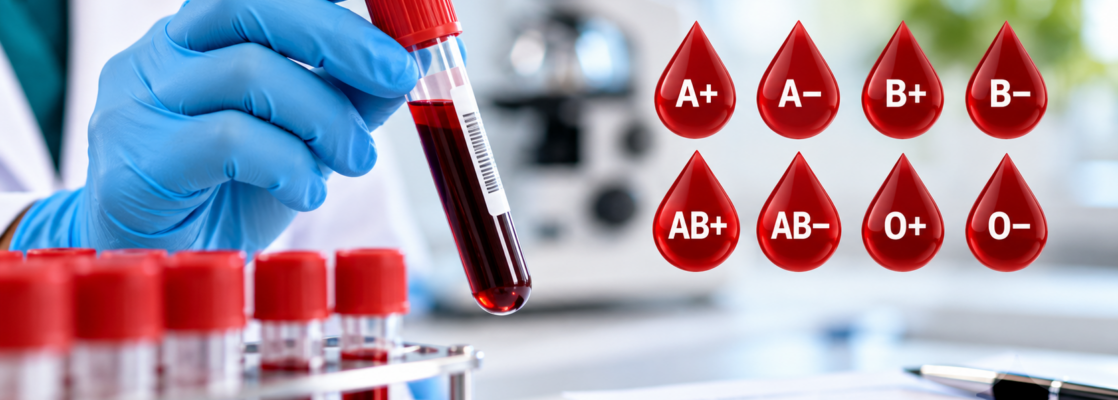
Combine the ABO group with the Rh status and you get the familiar eight blood types: A positive, A negative, B positive, B negative, AB positive, AB negative, O positive and O negative.
In many African populations, group O is the most common, followed by group A, then B, while AB is the rarest. Rh negative is far less common than Rh positive in most African communities, which makes it especially important to identify, particularly in pregnancy.
How Is Blood Group Testing Done?
Blood group testing, also known as blood typing, is simple, quick and low risk. A trained phlebotomist collects a small blood sample, usually from a vein in your arm. No fasting is needed and there is no special preparation.
In the laboratory, the sample is mixed with reagents containing known antibodies. If the red cells carry the matching antigen, they clump together in a reaction called agglutination. The pattern of clumping reveals your group.
A reliable blood group test normally includes two parts.
Forward typing checks your red cells for A, B and D antigens.
Reverse typing checks your plasma for the A and B antibodies you would be expected to have. When the forward and reverse results agree, the laboratory can be confident in the answer. If they do not agree, further investigation is done before a result is released.
Modern laboratories use a mix of tube methods, gel card technology and automated analyzers, all designed to reduce human error and speed up turnaround. Results are often available within a day, and in urgent cases much sooner.
Related tests you may hear about
Blood group testing often goes hand in hand with a few related investigations.
An antibody screen looks for unexpected antibodies that could cause problems in pregnancy or transfusion.
Crossmatching mixes a patient’s blood with a donor’s blood before a transfusion, as a final safety check.
A direct antiglobulin test, sometimes called a Coombs test, detects antibodies attached to red cells, which may help explain certain types of anemia or newborn jaundice.
Why Blood Group Testing Matters
1. Safe blood transfusions
This is the original and still the most critical purpose. In an accident, during childbirth or in major surgery, a transfusion can be the difference between life and death. Knowing the correct blood group, and matching it carefully, protects patients from reactions that can damage the kidneys, trigger shock or even cause death.
Group O negative red cells are often described as the universal donor type for emergencies because they lack A, B and D antigens. Group AB positive patients are sometimes called universal recipients for red cells. For plasma, the pattern is reversed, and AB is considered the universal donor type. This is why hospitals and blood banks pay such close attention to maintaining a balanced supply of every group.
2. Healthy pregnancies
Blood group testing is a cornerstone of antenatal care. Here is why.
If a mother is Rh negative and her baby is Rh positive, her immune system can sometimes become sensitized to the baby’s red cells, especially around delivery, after a miscarriage or following certain procedures. In a later pregnancy, her antibodies may cross the placenta and attack the baby’s red cells. This condition, known as hemolytic disease of the fetus and newborn, can cause severe anemia, jaundice and, in serious cases, harm to the baby.
The good news is that it is largely preventable. When an Rh negative mother is identified early, she can receive an injection of anti D immunoglobulin at the right times, which prevents sensitization. This simple measure has dramatically reduced the condition in places where it is routinely used. It only works if the mother’s blood group is known, which is why testing early in pregnancy is so important.
ABO differences between mother and baby can also occasionally cause newborn jaundice, which is another reason healthcare teams like to have blood group information on file.
3. Surgery and emergencies
Before planned surgery, hospitals routinely confirm blood group and keep compatible blood available. In an emergency, knowing your blood group in advance can save precious minutes. Many people choose to carry a card or keep the information in their phone’s medical ID.
4. Blood donation
If you want to become a donor, you will be blood typed as part of the process. Some groups are in particularly high demand, and rarer groups are especially valuable to blood banks. Knowing your type helps you understand how your donation can help.
5. Organ and tissue transplantation
Blood group compatibility is a key consideration in kidney, liver, heart and other transplants. In most cases, donor and recipient need to be ABO compatible, and specialized protocols exist for certain exceptions.
6. Family and genetic understanding
Blood groups are inherited. You receive one ABO gene from each parent, and the combinations follow predictable patterns. For example, two parents in group O can only have children in group O. A parent in group AB cannot have a child in group O. Blood group results are sometimes used as one piece of the puzzle in understanding family relationships, although they are not a substitute for DNA testing when parentage must be established with certainty.
Who Should Get Tested?
The short answer: almost everyone, and certainly anyone who does not already have a reliable, laboratory confirmed result. In particular, blood group testing is advisable for the following people.
- Women who are pregnant or planning a pregnancy.
- Anyone preparing for surgery or a medical procedure.
- People who want to donate blood.
- Parents who want a record for their newborns and children.
- Athletes, travelers, drivers and outdoor workers who face a higher risk of injury.
- Employees in high risk occupations, and organizations building emergency preparedness records.
- Couples planning a family who want to understand their inheritance patterns.
- Anyone who has never been tested, or who relies only on a guess, a verbal memory or a home kit.
Reading Your Results
Your report will show your ABO group and your Rh status, for example A positive or O negative. Keep it somewhere safe and share it with your doctor, your spouse or a trusted family member.
A few practical points are worth remembering.
Your blood group does not change during your lifetime under normal circumstances. The rare exceptions include certain bone marrow transplants and some serious blood disorders, so your medical team will update your records if that happens.
A blood group on a card or in an app should always be confirmed by a laboratory before a transfusion. Hospitals will retest regardless, because the cost of an error is simply too high.
Blood group testing for health decisions should be done in an accredited laboratory with quality control. Home or novelty kits may be fine for curiosity, but they should not be relied on for medical use.
Myths and Facts About Blood Groups
Myth: Your blood group determines your personality. Despite popular beliefs in some countries, there is no scientific evidence that blood type shapes character, intelligence or compatibility in love.
Myth: A special blood type diet will transform your health. Large reviews have not found good evidence that eating according to your blood group improves health outcomes. Healthy eating advice is broadly the same for everyone, tailored by individual conditions, not blood type.
Myth: Rh negative blood is dangerous or unusual in a harmful way. Being Rh negative is simply a variation. It matters mainly in pregnancy and transfusion, and it is easily managed with proper care.
Myth: Your blood group can be worked out from your parents’ groups alone. Inheritance can narrow the possibilities, but only a laboratory test confirms your actual type.
Fact: Some research links certain blood groups with differences in disease risk. For example, studies have observed that people who are not group O may have a somewhat higher risk of blood clots, and that group O may offer some protection against severe malaria. These associations are statistical and modest. They do not mean any blood group is destined to get sick, and they are not a reason to change your lifestyle on their own.
What to Expect When You Get Tested
A visit for blood group testing is straightforward.
You arrive, confirm your details and have a small sample taken. The process takes only a few minutes. There is no fasting, no special diet and no need to stop your usual medicines unless your doctor has advised otherwise. Your sample is labeled carefully, tested in the laboratory and reported with your ABO and Rh group.
If you are pregnant, your clinician may request additional tests such as an antibody screen, along with other antenatal investigations. If you are preparing for surgery, your hospital may repeat the test and perform a crossmatch closer to the date.
Frequently Asked Questions
How accurate is blood group testing? When performed in an accredited laboratory using forward and reverse typing and proper quality control, laboratory blood group testing is highly reliable.
Do I need to fast before a blood group test? No. You can eat and drink normally.
How long do results take? Many laboratories can issue results the same day or within 24 hours. Urgent requests are handled faster.
Can my blood group change? Not in normal circumstances. Only rare events such as certain stem cell or bone marrow transplants can change it.
Is my blood group the same as my genotype? No. Blood group refers to the antigens on your red cells. Genotype, in the sickle cell context, refers to your hemoglobin type. They are different tests, and many people choose to do both for a complete health picture.
Is it safe to rely on a blood group from childhood records? It is better to confirm with a current laboratory test, especially before pregnancy, surgery or donation.
Can blood group testing help with paternity? It can sometimes show that a particular parentage is impossible, but it cannot confirm a relationship. DNA testing is the reliable method for establishing biological relationships.
Take the Simple Step Today
Knowing your blood group costs very little and takes very little time, yet it can protect you and the people you love when a crisis arrives without warning. Think of it as a small piece of preparation that sits quietly in your wallet or phone until the day it matters most.
At Biopassion Diagnostics, our KMLTTB accredited laboratory in Nairobi offers accurate, timely and confidential blood group testing for individuals, families, expectant mothers, clinicians and organizations. Convenient sample collection and clear results are part of our promise.
Book your blood group test today.
Call or WhatsApp: +254 704 150 555
Biopassion Diagnostics: Your Health IS OUR PASSION.
This article is for general education and does not replace advice from a qualified healthcare professional. Speak to your doctor about the right tests for your situation.