
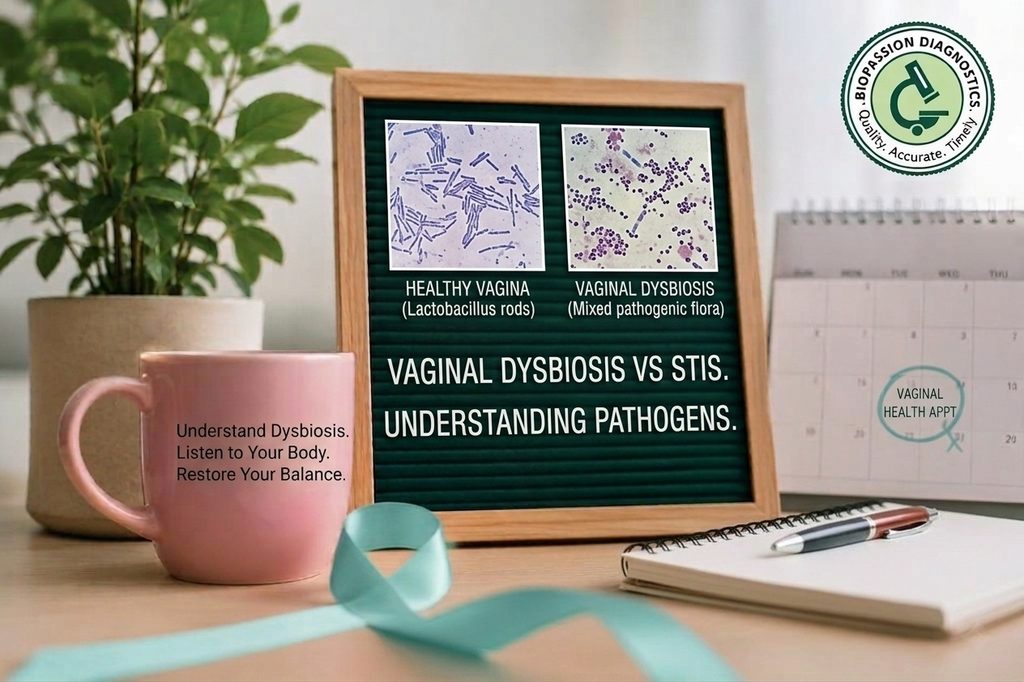
Vaginal Dysbiosis vs STI: What Is the Difference and When Should You Get Tested?
Vaginal discharge, unusual odour, itching or irritation does not always mean you have a sexually transmitted infection (STI). But how can you tell whether the cause is vaginal dysbiosis, bacterial vaginosis, a yeast infection or an STI?
Understanding the difference between vaginal dysbiosis and STIs is important because several vaginal conditions can produce similar symptoms, while some STIs may cause no noticeable symptoms at all.
If you are experiencing persistent vaginal symptoms or have concerns about a possible STI exposure, appropriate clinical assessment and STI testing can help identify the underlying cause.
Quick Answer: Is Vaginal Dysbiosis an STI?
No. Vaginal dysbiosis is not itself an STI.
Vaginal dysbiosis refers to a disruption or imbalance in the microorganisms that normally live in the vaginal environment. Bacterial vaginosis (BV) is a common condition associated with this type of microbial imbalance.
An STI, by contrast, is an infection that can be transmitted through sexual contact. Examples include chlamydia, gonorrhoea, trichomoniasis, syphilis, HIV and genital herpes.
However, the distinction is important because vaginal dysbiosis and STIs can produce overlapping symptoms, and they can occur at the same time.
What Is Vaginal Dysbiosis?
The vagina naturally contains a community of microorganisms known as the vaginal microbiome.
In a healthy vaginal environment, Lactobacillus species commonly play an important role in maintaining the vaginal microbial balance.
Vaginal dysbiosis occurs when this microbial balance is disrupted.
One of the most common conditions associated with vaginal dysbiosis is bacterial vaginosis.
According to the Centers for Disease Control and Prevention (CDC), BV is a vaginal dysbiosis involving changes in the normal vaginal bacterial community. The World Health Organization (WHO) similarly describes bacterial vaginosis as an imbalance between the microorganisms normally present in the vagina.
Changes in the vaginal environment may be associated with factors such as antibiotic use, hormonal changes, sexual activity, changes in vaginal pH and vaginal douching.
Importantly, vaginal dysbiosis should not automatically be interpreted as evidence of an STI.
What Is a Sexually Transmitted Infection (STI)?
A sexually transmitted infection (STI) is an infection that can be transmitted through sexual contact.
Common STIs include:
- Chlamydia
- Gonorrhoea
- Trichomoniasis
- Syphilis
- Genital herpes
- HIV
- Human papillomavirus (HPV)
Some STIs can cause symptoms such as unusual genital discharge, painful urination, pelvic pain, irritation or genital sores.
However, some STIs can cause few or no noticeable symptoms.
This means that someone may have an STI without knowing they are infected.
For this reason, STI testing may be appropriate even when a person does not have obvious symptoms, depending on their individual circumstances and potential exposure.
Vaginal Dysbiosis vs STI: What Is the Difference?
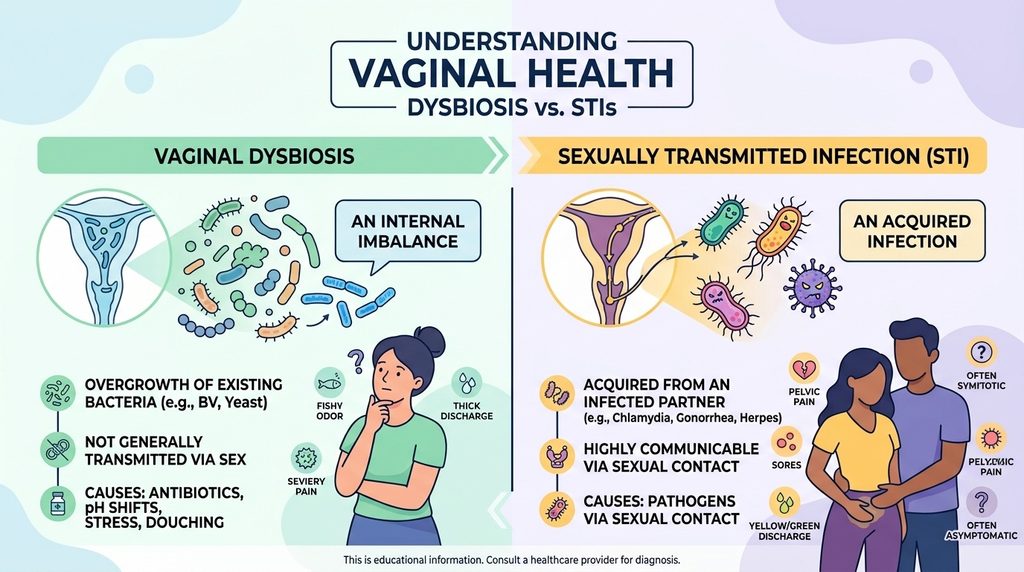
The main difference between vaginal dysbiosis and an STI is their underlying cause.
Vaginal dysbiosis occurs when the normal balance of microorganisms in the vaginal microbiome is disrupted. It may be associated with changes in vaginal discharge, unusual odour, irritation or discomfort.
STIs, on the other hand, are infections that can be transmitted through sexual contact. Depending on the infection, they may cause unusual discharge, irritation, burning during urination, pelvic pain or genital sores and lesions.
The difficulty is that these symptoms can overlap significantly.
Both vaginal dysbiosis and STIs can also occur without noticeable symptoms. Therefore, symptoms alone cannot reliably distinguish between vaginal dysbiosis, bacterial vaginosis, candidiasis (yeast infection), trichomoniasis and other STIs.
When symptoms persist, recur or follow a potential STI exposure, appropriate clinical assessment and laboratory testing can help identify the underlying cause and guide appropriate management.
Can Vaginal Dysbiosis Be Mistaken for an STI?
Yes.
Changes in vaginal discharge, odour, irritation or discomfort can occur with several different conditions.
For example, similar symptoms may occur with:
- Bacterial vaginosis
- Candidiasis (yeast infection)
- Trichomoniasis
- Chlamydia
- Gonorrhoea
- Other vaginal or genital conditions
This makes self-diagnosis unreliable.
The CDC notes that a medical history alone is often insufficient to accurately determine the cause of vaginal symptoms. Clinical assessment and appropriate laboratory testing can therefore be important when evaluating vaginal discharge, itching, burning, irritation or odour.
If an STI is a concern, STI/STD testing at Biopassion Diagnostics can help investigate several possible sexually transmitted infections.
Can You Have Vaginal Dysbiosis and an STI at the Same Time?
Yes.
Having bacterial vaginosis or another form of vaginal dysbiosis does not exclude the possibility of an STI.
A person can have more than one condition at the same time.
For example, someone experiencing symptoms that appear consistent with BV may also have an STI, particularly if there has been a potential exposure.
This is why STI testing may still be appropriate when vaginal dysbiosis or BV is suspected.
What Are the Symptoms of Vaginal Dysbiosis?
Symptoms vary from person to person, and some people may have no obvious symptoms.
Possible symptoms associated with bacterial vaginosis and vaginal microbial imbalance include:
- A change in vaginal discharge
- Increased or unusual discharge
- Strong or unusual vaginal odour
- Vaginal irritation
- Burning during urination
- Vaginal discomfort
However, these symptoms are not specific to vaginal dysbiosis and may occur with other vaginal infections or STIs.
What Are the Symptoms of an STI?
STI symptoms vary depending on the infection.
Possible symptoms include:
- Unusual genital or vaginal discharge
- Burning or pain during urination
- Pelvic or lower abdominal pain
- Genital itching or irritation
- Pain during sexual intercourse
- Genital sores or blisters
- Swollen lymph nodes
- Bleeding between periods
- Testicular pain or swelling in some infections
However, the absence of symptoms does not necessarily mean an STI is absent.
Some sexually transmitted infections can remain asymptomatic, which is why testing can be important after a potential exposure or when screening is recommended.
For example, if your healthcare provider suspects chlamydia or gonorrhoea, chlamydia and gonorrhoea testing may be considered according to the clinical situation.
Is Vaginal Dysbiosis Caused by Poor Hygiene?
Not necessarily.
Vaginal dysbiosis is associated with changes in the vaginal microbial environment and can occur for several reasons.
It should not automatically be interpreted as a sign of poor personal hygiene.
In fact, practices such as vaginal douching can disrupt the vaginal environment and may increase the risk of bacterial vaginosis.
If you experience persistent vaginal symptoms, seeking professional medical advice is preferable to repeatedly using products designed to mask odour or irritation.
Does Vaginal Dysbiosis Mean Someone Has an STI?
No.
Vaginal dysbiosis, including bacterial vaginosis, is not itself proof that someone has an STI.
However, because symptoms may overlap and multiple conditions can occur together, appropriate testing may be recommended depending on the individual’s symptoms, clinical history and potential exposure.
This distinction is important because vaginal symptoms should not automatically be associated with sexual behaviour or infidelity.
When Should You Get Tested for an STI?
Consider discussing STI testing with a healthcare professional if you:
- Have new or unusual vaginal or genital discharge
- Notice persistent or unusual vaginal odour
- Experience vaginal itching or irritation
- Have burning or pain when urinating
- Experience pelvic or lower abdominal pain
- Have pain during sexual intercourse
- Develop genital sores or lesions
- Have symptoms following a new sexual partner
- Have had a potential STI exposure
- Have a sexual partner diagnosed with an STI
- Experience recurrent or unexplained vaginal symptoms
- Remain concerned about an STI even without symptoms
The appropriate tests and timing depend on the infection being considered and the circumstances of a possible exposure.
Where several infections need to be considered, your healthcare provider may recommend STD panel testing rather than testing for only one infection.
What Tests May Be Needed?
The appropriate laboratory tests depend on your symptoms, clinical assessment and potential exposure.
Depending on the circumstances, investigations may include testing for:
Vaginal conditions: bacterial vaginosis, Candida/yeast infection and trichomoniasis.
STIs: chlamydia, gonorrhoea, trichomoniasis, syphilis, HIV and other infections where clinically indicated.
For women concerned about HPV, HPV testing may also be appropriate depending on the clinical context and applicable screening recommendations.
Where clinically indicated following a potential exposure, HIV testing may form part of a broader sexual-health assessment.
If genital sores or blisters are present, clinical assessment may determine whether herpes testing is appropriate.
You can also browse Biopassion Diagnostics laboratory tests to explore the wider range of available investigations.
A healthcare professional can help determine which tests are appropriate for your situation.
Why Is Laboratory Testing Important?
Several vaginal conditions can produce similar symptoms, but they may require different approaches to management.
Laboratory testing can provide objective information that helps healthcare professionals distinguish between possible causes.
Testing can be particularly useful when symptoms are:
- Persistent
- Recurrent
- Unexplained
- Not improving after previous treatment
- Associated with a potential STI exposure
- Suggestive of more than one possible infection
Rather than assuming the cause, appropriate testing can help provide clearer answers.
If you are preparing for laboratory testing, you can review Biopassion Diagnostics’ test preparation guidance or contact the laboratory if you are unsure about specimen or preparation requirements.
Can You Have an STI Without Symptoms?
Yes.
Some STIs may produce no noticeable symptoms.
This is one reason why relying only on symptoms can be misleading.
A person may feel completely well and still have an STI. If there has been a potential exposure, a new sexual partner or another reason for concern, discussing appropriate screening with a healthcare professional can help determine whether testing is recommended.
Vaginal Dysbiosis vs STI: What Should You Remember?
Vaginal dysbiosis and STIs are different conditions, but their symptoms can overlap.
Vaginal dysbiosis refers to an imbalance in the vaginal microbial environment, while an STI is an infection that can be transmitted through sexual contact.
Bacterial vaginosis is associated with vaginal dysbiosis and is not classified as an STI. However, BV and STIs can occur at the same time.
The most important point is that symptoms alone cannot always tell you what is causing a vaginal or genital problem.
If symptoms persist, recur or follow a potential exposure, appropriate clinical assessment and laboratory testing can help identify the cause.
Don’t Guess About Your Vaginal Health
Vaginal discharge, odour, itching, irritation or discomfort can have different causes.
It is not always an STI. But it should not simply be ignored either.
If you are concerned about your vaginal health or have experienced a potential STI exposure, speak with a qualified healthcare professional about the appropriate assessment and testing.
At Biopassion Diagnostics, laboratory testing supports informed healthcare decisions by helping investigate possible vaginal and sexually transmitted infections.
Book Your Vaginal Health or STI Test
Don’t keep guessing about your symptoms. Find out what may be causing them.
Enquire about STI testing at Biopassion Diagnostics to discuss appropriate testing for your circumstances.
You can also contact Biopassion Diagnostics if you have questions about testing, specimen collection or available laboratory investigations.
Know what is happening. Get the right test. Take the right next step.
Biopassion Diagnostics
Accurate. Advanced. Accessible Diagnostics.
Frequently Asked Questions About Vaginal Dysbiosis vs STI
Is vaginal dysbiosis the same as an STI?
No. Vaginal dysbiosis is an imbalance in the vaginal microbiome and is not itself classified as an STI. Bacterial vaginosis is a common condition associated with vaginal dysbiosis.
Is bacterial vaginosis an STI?
No. Bacterial vaginosis is not classified as an STI. However, sexual activity can be associated with an increased risk of BV, and BV can occur alongside an STI.
Can BV be mistaken for an STI?
Yes. BV and some STIs can cause similar symptoms, including unusual discharge, odour and discomfort. Appropriate assessment and testing may be needed to determine the cause.
Can you have BV and an STI at the same time?
Yes. Having BV does not rule out an STI. More than one condition can occur at the same time.
Can an STI have no symptoms?
Yes. Some STIs can cause no noticeable symptoms. This is why testing may be recommended following a potential exposure or when screening is appropriate.
Should I get tested if I have no symptoms?
If you have had a potential STI exposure, a new sexual partner or another reason for concern, discuss STI screening with a healthcare professional. The appropriate tests depend on your circumstances.
What causes vaginal dysbiosis?
Vaginal dysbiosis involves a disruption in the normal vaginal microbial environment. Factors associated with changes in the vaginal microbiome can include antibiotic use, hormonal changes, sexual activity, changes in vaginal pH and vaginal douching.
How do I know whether my symptoms are BV, a yeast infection or an STI?
Symptoms alone may not provide a reliable answer because several vaginal conditions can produce similar symptoms. A healthcare professional can assess your symptoms and determine whether laboratory testing is appropriate.
Medical Review & Evidence
Medically reviewed by: ERICK MASIGA (Biopassion Diagnostics Laboratory Manager)
Published: September 2026
Last medically reviewed: September 2026
Next scheduled review: September 2027
This article is intended for general health education and does not replace consultation with a qualified healthcare professional. Testing and treatment decisions should be based on individual clinical circumstances.
Medical References
- World Health Organization (WHO). Bacterial vaginosis. WHO, 21 November 2025.
- World Health Organization (WHO). Sexually transmitted infections (STIs). WHO.
- World Health Organization (WHO). Recommendations for the treatment of Trichomonas vaginalis, Mycoplasma genitalium, Candida albicans, bacterial vaginosis and human papillomavirus. WHO, 2024.
- Centers for Disease Control and Prevention (CDC). Bacterial Vaginosis — STI Treatment Guidelines.
- Centers for Disease Control and Prevention (CDC). Diseases Characterized by Vulvovaginal Itching, Burning, Irritation, Odor or Discharge.
- Centers for Disease Control and Prevention (CDC). Sexually Transmitted Infections Treatment Guidelines.
Medical evidence reviewed against WHO and CDC guidance at the time of publication.
A: No. Vaginal dysbiosis is an imbalance in the vaginal microbiome and is not itself classified as an STI. Bacterial vaginosis is a common condition associated with vaginal dysbiosis.
A: No. Bacterial vaginosis is not classified as an STI. However, sexual activity can be associated with an increased risk of BV, and BV can occur alongside an STI.
A: Yes. BV and some STIs can cause similar symptoms, including unusual discharge, odour, and discomfort. Appropriate assessment and testing may be needed to determine the cause.
A: Yes. Having BV does not rule out an STI. More than one condition can occur at the same time.
A: Yes. Some STIs can cause no noticeable symptoms. This is why testing may be recommended following a potential exposure or when screening is appropriate.
A: If you have had a potential STI exposure, a new sexual partner, or another reason for concern, discuss STI screening with a healthcare professional. The appropriate tests depend on your circumstances.
A: Vaginal dysbiosis involves a disruption in the normal vaginal microbial environment. Factors associated with changes in the vaginal microbiome can include antibiotic use, hormonal changes, sexual activity, changes in vaginal pH, and vaginal douching.
A: Symptoms alone may not provide a reliable answer because several vaginal conditions can produce similar symptoms. A healthcare professional can assess your symptoms and determine whether laboratory testing is appropriate.
A: Biopassion Diagnostics offers accredited (KMLTTB) lab testing for bacterial vaginosis, yeast infections, and STIs. Call +254 704 150 555 or visit www.biopassiondiagnostics.com to book a test.
Book your test today:
Call/WhatsApp: +254 704 150 555
Website: www.biopassiondiagnostics.com
Don’t guess the cause of your symptoms. Get tested and know your status.
Symptoms alone are often not enough to distinguish between BV, a yeast infection, and certain STIs. Discharge, itching, irritation, odour, or discomfort can occur with several different conditions. Laboratory testing can help identify the specific cause so that appropriate treatment can be provided.
-
(13)
-
(2)
-
(1)
Your Partner Should Be Tested Too.
If you test positive for an STI, your partner should also be tested—even if they have no symptoms.
Your Partner Should Be Tested Too.
If you test positive for an STI, your partner should also be tested—even if they have no symptoms.
Many STIs can be present without obvious signs. Testing both partners helps identify infections early, guide appropriate treatment, and reduce the risk of reinfection.
Don’t assume. Test. Know. Protect each other.
Don’t wait—book your STI Panel today.
Get tested, get clarity, and take the next step toward protecting both of you.
Book your appointment with Biopassion Diagnostics now.