The Test That Explains the Tiredness You Can’t Explain
Picture this: you’re sleeping enough, eating reasonably well, not overworked by any obvious measure, and yet you’re tired in a way that coffee doesn’t fix. Stairs feel steeper than they used to.

You catch every cold going around the office. Maybe you’ve even started wondering if it’s “just stress” or “just getting older.”
Here’s the thing: sometimes it isn’t either. Sometimes it’s something a single tube of blood can explain in a day.
That test is called a Complete Blood Count, (CBC) and it’s probably the most quietly powerful test in modern medicine that almost nobody talks about at dinner parties
What’s Actually in a Drop of Your Blood
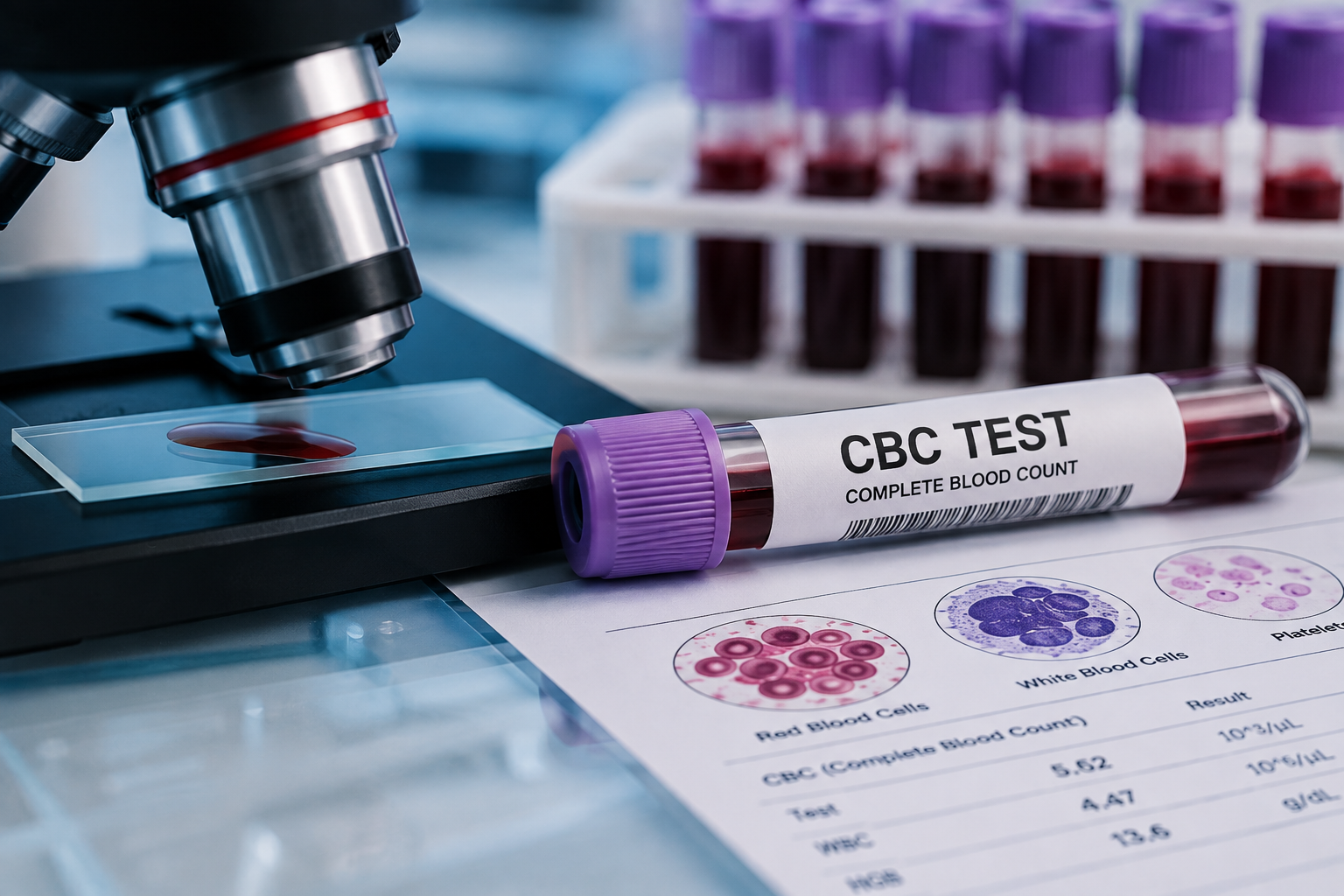
Blood looks simple from the outside, just red liquid. Under a lab analyzer, it’s closer to a census report. A CBC counts and measures three main populations living in your bloodstream:
Red blood cells, the oxygen couriers. Too few, and your organs run on a low-oxygen budget which, unsurprisingly, feels exactly like the fatigue described above.
White blood cells, your immune system’s standing army. Numbers that are too high or too low can point to infection, inflammation, or something that needs a closer look.
Platelets, the emergency repair crew that stops bleeding. Too few, and small bumps bruise easily or cuts take longer to stop bleeding. Too many, and clotting risk climbs.
Around these three headline numbers sit supporting details; hemoglobin, hematocrit, and cell-size measurements that help a clinician tell what kind of problem they might be looking at, not just that one exists.
The Story Behind the Numbers
Here’s where it gets less abstract. Anemia, characterized by low red blood cell or hemoglobin levels, is the most frequently detected abnormality on a routine Complete Blood Count (CBC) and presents a significant, widespread clinical reality rather than a rare finding. Recent global burden-of-disease research estimates that anemia affects roughly 1.92 billion people worldwide, close to a quarter of the entire global population [1]. It disproportionately affects women: 31.2% of women are affected compared to 17.5% of men, and among women of reproductive age, prevalence climbs to nearly 34%.
Sit with that for a second. Statistically, in any room of ten adult women, three are likely dealing with some degree of anemia, many without knowing it, because “tired” is so easy to write off as normal life.
Regionally, the burden isn’t distributed evenly. Research on global anemia trends consistently identifies sub-Saharan Africa and South Asia as the regions carrying the heaviest share of cases, meaning for a lot of us, this isn’t a distant statistic. It’s a neighbor, a colleague, possibly the person reading this.
Why “I’ll Just Push Through It” Isn’t a Strategy
Unexplained fatigue is one of the most common reasons people delay getting checked, precisely because it’s vague. It doesn’t feel like an emergency. But a CBC is one of the fastest, cheapest ways to turn “I don’t know why I feel like this” into an actual answer. It can reveal:
- Iron-deficiency anemia (often fixable with diet and supplementation)
- An infection your body is actively fighting, even without obvious symptoms
- Early signs of a bleeding or clotting issue
- In rarer cases, markers that prompt further investigation into blood disorders
None of these get better by waiting them out. All of them get easier to treat the earlier they’re caught.
What Getting Tested Actually Looks Like
There’s no drama to it. A small blood sample, drawn in minutes, no fasting required in most cases. Results are typically ready within hours to a day. That’s genuinely it. No elaborate prep, no discomfort worth mentioning, no reason it should sit on a to-do list for months.
The Real Point
Fatigue is often dismissed as a mood, a phase, a personality trait. “I’m just not a morning person.” Sometimes that’s true. But sometimes your blood is telling a very specific, very fixable story, and the only way to hear it is to ask.
If your tiredness has been unexplained for a while, a CBC isn’t an overreaction. It’s the first, most obvious question worth answering.