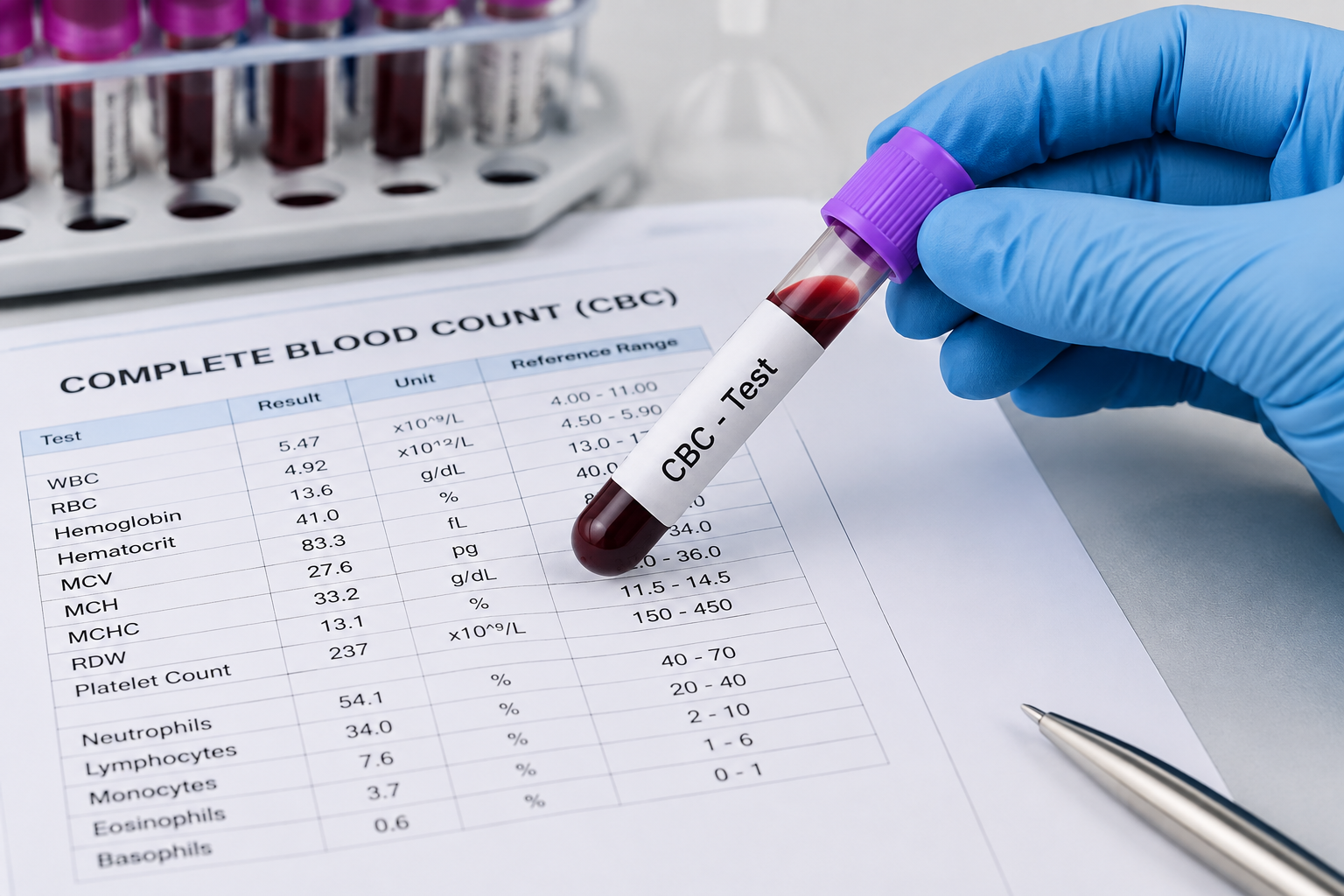
What Does a CBC Blood Test Check?
A CBC test essentially gives a snapshot of the major cellular components of your blood.
1. Red Blood Cell Count
Red Blood Cells (RBCs) are responsible for transporting oxygen from the lungs to tissues throughout the body and carrying carbon dioxide back toward the lungs.
The RBC count measures the number of red blood cells in a specific volume of blood.
A result outside the laboratory’s reference range does not automatically mean that you have a disease. RBC levels can be influenced by several factors, including hydration status, altitude, smoking, pregnancy, medical conditions and other circumstances.
A healthcare professional therefore interprets the RBC count alongside haemoglobin, haematocrit and the red blood cell indices.
2. Haemoglobin
Haemoglobin (Hb) is a protein inside red blood cells that carries oxygen.
Haemoglobin is one of the most important measurements in a CBC because reduced haemoglobin can be associated with anaemia.
Anaemia is not a single disease. It can have many causes, including iron deficiency, blood loss, nutritional deficiencies, chronic disease and inherited conditions.
A low haemoglobin result should therefore not simply be treated as “low blood.” The underlying cause needs to be considered.
A CBC may provide clues about the type or pattern of anaemia, but additional tests may sometimes be necessary.
Depending on the clinical situation, these may include iron studies, ferritin, vitamin B12, folate, kidney function tests, reticulocyte count or other investigations.
3. Haematocrit or Packed Cell Volume
Haematocrit (HCT), sometimes reported as Packed Cell Volume (PCV), represents the proportion of blood volume occupied by red blood cells.
For example, if a person’s haematocrit is reported as a percentage, it indicates the percentage of their blood volume made up of red blood cells.
Haematocrit is usually considered together with haemoglobin and RBC measurements.
Changes may occur with conditions affecting red blood cell production, blood loss, hydration and other physiological or medical factors.
4. Mean Corpuscular Volume – MCV
MCV stands for Mean Corpuscular Volume.
It describes the average size of red blood cells.
MCV can be particularly useful when healthcare professionals are evaluating patterns of anaemia.
A lower MCV indicates that red blood cells are, on average, smaller than expected. This pattern can occur in conditions such as iron deficiency and some inherited blood disorders.
A higher MCV means the red blood cells are, on average, larger than expected. This can occur in several situations, including vitamin B12 or folate deficiency, among other causes.
MCV should never be interpreted alone.
5. Mean Corpuscular Haemoglobin – MCH
MCH represents the average amount of haemoglobin contained in an individual red blood cell.
It is one of the red blood cell indices reported as part of many CBC tests.
MCH is considered alongside other measurements such as MCV, MCHC, haemoglobin and RDW.
Together, these indices can help healthcare professionals understand the characteristics of red blood cells and identify patterns that may warrant further investigation.
6. Mean Corpuscular Haemoglobin Concentration – MCHC
MCHC stands for Mean Corpuscular Haemoglobin Concentration.
It provides information about the concentration of haemoglobin within red blood cells.
Like MCH and MCV, MCHC is primarily useful when considered as part of the wider red blood cell profile rather than as a standalone diagnostic measurement.
7. Red Cell Distribution Width — RDW
RDW, or Red Cell Distribution Width, provides information about the variation in the size of red blood cells.
When there is greater variation in red blood cell size, the RDW may be increased.
RDW can provide additional context when evaluating anaemia and other changes affecting red blood cells.
For example, a healthcare professional may look at the combination of haemoglobin, MCV and RDW to identify patterns that could suggest the need for further testing.
Again, an abnormal RDW does not diagnose a specific disease on its own.
8. White Blood Cell Count
White Blood Cells (WBCs) are an important part of the body’s immune system.
They help the body respond to infections, inflammation and other biological challenges.
The total WBC count measures the number of white blood cells in a given volume of blood.
A high WBC count may occur in several situations, including infections, inflammation, physical stress and certain medications. A low WBC count can also have multiple causes.
The total WBC count is therefore only part of the story.
This is why the white blood cell differential can be particularly useful.
9. Neutrophils
Neutrophils are a type of white blood cell that plays an important role in the body’s immune response, particularly against many bacterial infections.
CBC reports may provide the neutrophil count or percentage, depending on the laboratory reporting format.
Changes in neutrophil levels can occur for many reasons. These may include infections, inflammation, medications and other medical conditions.
Healthcare professionals may also pay attention to the Absolute Neutrophil Count (ANC) when clinically appropriate.
10. Lymphocytes
Lymphocytes are another major type of white blood cell.
They include cells involved in adaptive immune responses, including B cells and T cells.
Lymphocyte levels can change during different infections and immune responses.
An elevated or reduced lymphocyte count does not automatically identify a particular disease. Interpretation depends on the patient’s age, symptoms, clinical history and the overall CBC pattern.
11. Monocytes
Monocytes are white blood cells involved in immune defence and inflammatory processes.
They can migrate into tissues and develop into cells such as macrophages.
Changes in monocyte levels can occur in various infections, inflammatory conditions and other situations.
As with other CBC measurements, the result needs to be interpreted in context.
12. Eosinophils
Eosinophils are white blood cells associated with certain immune responses.
They can become elevated in situations such as some allergic conditions and parasitic infections, although there are other possible causes.
An elevated eosinophil count therefore does not automatically mean that someone has a parasite or an allergy.
The result needs to be assessed together with symptoms, history and, when appropriate, other tests.
13. Basophils
Basophils are another type of white blood cell involved in immune and inflammatory responses.
They are normally present in relatively small numbers compared with some other white blood cell types.
Although basophils are included in many differential white blood cell counts, their results are generally interpreted as part of the overall white blood cell picture.
14. Platelet Count
Platelets, also known as thrombocytes, are small blood components that play a critical role in blood clotting.
The platelet count measures the number of platelets in a given volume of blood.
A platelet count that is lower or higher than the laboratory’s reference range can have many possible causes.
Low platelet levels can be associated with an increased tendency to bleed in some circumstances, while high platelet levels can also have several possible causes.
However, the clinical significance depends on the degree of change, symptoms, other laboratory results and the individual’s medical history.
15. Mean Platelet Volume – MPV
MPV, or Mean Platelet Volume, measures the average size of platelets.
Platelet size can provide additional information about platelet production and turnover.
MPV is normally interpreted alongside the platelet count rather than being used independently.
Why Do Doctors Request a CBC Test?
A CBC can be requested for many different reasons.
It may be included as part of a routine health assessment or requested when someone develops symptoms that could be associated with changes in blood cells.
Common reasons include:
Unexplained tiredness or weakness
Suspected anaemia
Fever
Suspected infection
Recurrent infections
Unexplained bruising
Unusual or prolonged bleeding
Monitoring certain medical conditions
Monitoring the effects of some medications
Pre-operative assessment
Pregnancy-related assessment
General health screening
Follow-up after previous abnormal blood results
It is important to remember that a CBC is a laboratory investigation, not a complete diagnosis by itself.
A healthcare professional may order additional tests depending on the findings.
CBC and Anaemia
One of the most common reasons people hear about CBC testing is in relation to anaemia.
Anaemia occurs when the blood does not have enough healthy red blood cells or haemoglobin to adequately meet the body’s needs.
Symptoms can include fatigue, weakness, dizziness, shortness of breath or reduced exercise tolerance, although symptoms vary and may also have many other causes.
A CBC can identify patterns consistent with anaemia by looking at measurements such as:
Haemoglobin
Haematocrit
RBC count
MCV
MCH
MCHC
RDW
However, a CBC may not identify the underlying cause.
For example, additional testing may be needed to investigate iron deficiency, vitamin deficiencies, chronic disease or other causes.
CBC and Infection
White blood cells are an important part of the body’s defence against infection.
For this reason, healthcare professionals may request a CBC when someone has symptoms such as fever or other signs of illness.
The WBC count and differential may provide useful information about the body’s immune response.
However, it is important not to interpret a high or low WBC count as proof of infection.
Many conditions can affect white blood cell counts, and infections themselves can produce different patterns depending on the type, stage and severity of the illness.
Does a CBC Detect Every Disease?
No.
A CBC is an important and versatile blood test, but it does not test for every disease.
It does not replace tests specifically designed to investigate conditions involving organs, hormones, infections, nutrients, antibodies, genetics or other biological markers.
For example, a CBC alone cannot provide a complete assessment of kidney function, liver function, thyroid function, blood glucose or cholesterol.
Additional tests may be required depending on the individual’s symptoms and clinical needs.
Think of a CBC as one important piece of the health puzzle, not the entire puzzle.
Do You Need to Fast for a CBC Blood Test?
In many situations, fasting is not required for a CBC alone.
However, if your CBC is being performed together with other blood tests, such as fasting glucose or a lipid profile, your healthcare provider or laboratory may give you specific preparation instructions.
Always follow the preparation instructions provided for your particular test panel.
If you are unsure whether you need to fast, ask the laboratory or healthcare professional before your appointment.
How Is a CBC Blood Test Done?
A CBC is generally straightforward.
A trained healthcare professional collects a small blood sample, usually from a vein in your arm.
The blood is placed into an appropriate collection tube and labelled correctly before being transported or processed in the laboratory.
The sample is then analysed using a haematology analyser.
The analyser measures and classifies blood cells and generates a laboratory report.
The report will normally show the measured result alongside a reference range used by that laboratory.
How Long Does a CBC Test Take?
The time required to obtain CBC results can vary depending on the laboratory, workload, location and whether the test is being performed as part of a larger panel.
Many laboratories can process routine CBC testing relatively quickly.
However, turnaround time should always be confirmed directly with the laboratory performing the test.
Understanding CBC Reference Ranges
One of the most important things to understand about laboratory results is that reference ranges can vary between laboratories.
Your report will usually show the reference interval applicable to the testing laboratory.
Therefore, do not assume that a result outside a reference range automatically means you have a disease.
Similarly, a result inside a reference range does not necessarily mean that everything is normal.
Your healthcare professional considers the result together with your symptoms, age, sex, pregnancy status where applicable, medical history, medications and other findings.
What If My CBC Result Is Abnormal?
First, don’t panic.
An abnormal CBC result does not automatically mean that you have a serious illness.
Laboratory values can be affected by many factors.
Sometimes a result may be temporarily altered by infection, inflammation, dehydration, medication, physiological changes or other circumstances.
If a result is abnormal, a healthcare professional may:
Review your symptoms and medical history.
Examine the complete CBC pattern.
Compare the result with previous laboratory results.
Repeat the test if appropriate.
Request additional laboratory investigations.
Recommend further clinical evaluation.
The correct next step depends on the individual situation.
Why You Shouldn’t Interpret One CBC Number Alone
One of the biggest mistakes people make when reading laboratory reports is focusing on a single number.
For example, seeing a high WBC count and immediately concluding “I have an infection” may be inaccurate.
Similarly, seeing a low haemoglobin result and assuming the only explanation is iron deficiency may be incorrect.
Laboratory medicine is about patterns and context.
A healthcare professional may interpret several CBC parameters together.
For red blood cells, this could include haemoglobin, haematocrit, RBC count, MCV, MCH, MCHC and RDW.
For white blood cells, the total WBC count can be considered together with the differential.
For platelets, the platelet count can be considered alongside MPV and the clinical situation.
This broader approach provides a much more meaningful interpretation.
CBC Test in Kenya
CBC testing is widely used in medical practice in Kenya and around the world.
If you are looking for a CBC blood test in Kenya, it is important to choose a laboratory that follows appropriate sample collection, identification, processing and quality-control procedures.
For people searching for a CBC test in Nairobi, Biopassion Diagnostics provides laboratory testing services designed to support informed healthcare decisions.
Our approach is centered on accuracy, professionalism, confidentiality and patient-focused service.
Whether you are seeking testing because of symptoms or as part of a broader health assessment, speak with a qualified healthcare professional about which tests are appropriate for you.
CBC Blood Test in Nairobi
If you are searching online for:
CBC test near me
CBC blood test Nairobi
Complete Blood Count Nairobi
CBC laboratory Kenya
Blood test Nairobi
or medical laboratory Nairobi, understanding what the test includes is an important first step.
At Biopassion Diagnostics, we aim to make laboratory testing easier to understand while maintaining a professional and science-driven approach.
Our laboratory services are designed to help individuals, families, healthcare professionals and organisations access reliable diagnostic testing.
For CBC testing and other laboratory services, contact the Biopassion Diagnostics team for current availability, pricing and turnaround time.
When Should You Consider a CBC?
There is no single rule that says every person must have a CBC at a particular frequency.
The appropriate timing depends on your health status, symptoms, age, medical history, medications and your healthcare professional’s recommendations.
A CBC may be appropriate when there are symptoms or clinical reasons to investigate blood cell abnormalities.
It may also be included in broader health assessments or monitoring programmes.
Rather than ordering tests simply because they are available, discuss your health concerns with a qualified healthcare professional and determine which tests are appropriate.
CBC Testing Is About More Than Numbers
A laboratory report can sometimes look intimidating.
You may see abbreviations such as:
Hb
RBC
HCT
MCV
MCH
MCHC
RDW
WBC
NEUT
LYMPH
MONO
EOS
BASO
PLT
MPV
These are not random numbers.
Each measurement provides a different piece of information about your blood.
When considered together, they can help healthcare professionals identify patterns and decide whether further investigation is needed.
That is why understanding your CBC is important—but professional interpretation is equally important.
The Bottom Line
A CBC blood test, or Complete Blood Count, is one of the most useful routine laboratory investigations.
It examines major components of your blood, including:
🔴 Red blood cells
🩸 Haemoglobin
🩸 Haematocrit/PCV
🔬 MCV
🔬 MCH
🔬 MCHC
🔬 RDW
⚪ White blood cells
⚪ Neutrophils
⚪ Lymphocytes
⚪ Monocytes
⚪ Eosinophils
⚪ Basophils
🩸 Platelets
🔬 MPV
Together, these measurements can provide valuable information about your blood and may help healthcare professionals investigate conditions such as anaemia, infection, inflammation and blood-cell abnormalities.
But remember: a CBC is not a diagnosis by itself.
Your results should be interpreted using the reference ranges on your laboratory report and considered alongside your symptoms, medical history and other clinical findings.
If your CBC results are abnormal, speak with a qualified healthcare professional rather than trying to diagnose yourself from a single number.
Looking for a CBC Blood Test in Nairobi, Kenya?
If you need a CBC test in Nairobi, Biopassion Diagnostics is committed to making laboratory testing accurate, accessible and easier to understand.
Our team provides diagnostic laboratory services for individuals and organisations while maintaining a strong focus on quality and patient care.
📍 Biopassion Diagnostics
📞 +254 704 150 555
Your Health IS OUR PASSION.
Before taking any laboratory test, confirm the required preparation, current test availability, price and turnaround time with the laboratory.