There’s a number that should be on every calendar reminder, every bathroom mirror, every annual to-do list: 99%.
That’s the five-year relative survival rate for breast cancer caught at an early, localized stage, before it has spread beyond the breast. Compare that to survival odds that fall sharply once cancer reaches an advanced, distant stage, and the message becomes impossible to ignore: timing is everything.
This isn’t a scare story. It’s a story about how much power we already have, and how unevenly that power is being used around the world.
The Numbers That Matter
Breast cancer is the most frequently diagnosed cancer among women in 158 countries, and it is the leading cause of both cancer diagnosis and cancer death among women worldwide. In 2024, an estimated 2.4 million women were newly diagnosed globally, and roughly 694,000 women died from the disease, about 70% of those deaths occurring in low- and middle-income countries.
Those numbers sound grim on their own. But sit them next to this one: in high-income countries, age-standardized breast cancer mortality has fallen by about 40% since the 1980s, a decline researchers attribute mainly to earlier diagnosis through screening and to steadily improving treatment. That’s not an abstraction. That’s hundreds of thousands of lives extended because cancer was found sooner rather than later.
The World Health Organization’s Global Breast Cancer Initiative has set a target that 60% of invasive breast cancers be diagnosed at stage I or II, the stage where treatment tends to work best and survival odds are highest. Meeting that target, alongside timely diagnosis and full treatment access, is projected to help avert 2.5 million deaths globally by 2040.
Why “Early” Changes Everything
Cancer staging isn’t just paperwork for doctors. It’s the single biggest factor in how treatable a cancer is. A tumor caught while it’s still confined to breast tissue is, in most cases, smaller, more likely to be removable with less invasive surgery, and far less likely to have sent cells traveling to the lymph nodes, bones, lungs, or liver. Once that spread happens, treatment becomes more aggressive, more prolonged, and less certain in its outcome.
This is the entire logic behind screening: mammograms, clinical breast exams, and self-awareness aren’t about preventing cancer from forming. They’re about catching it while it’s still small, still local, and still highly treatable, often before a person can feel anything unusual at all.
Early Detection Isn’t One Habit, It’s Three
Health organizations generally point to a layered approach, since no single method catches everything on its own:
1. Know what’s normal for you. Breast self-awareness, simply knowing how your breasts typically look and feel, helps you notice changes early: a new lump, thickening, dimpling, nipple changes, or unusual discharge. You don’t need a formal technique so much as familiarity.
2. Clinical breast exams. A trained provider can detect changes during a routine physical that might be missed at home, and can help guide next steps if something feels off.
3. Mammography on schedule. Mammograms can detect tumors years before they’d be large enough to feel, which is precisely why regular screening, not just reactive visits when something feels wrong, is the backbone of early detection.
The Gaps We Can’t Ignore
Early detection isn’t reaching everyone equally, and the global data is candid about that. Researchers use a measure called the mortality-to-incidence ratio (MIR) to compare survival across regions, and it tells a stark story. The ratio sits at a relatively favorable 18% in the most developed countries, but climbs to 56% in less developed regions, reflecting later-stage diagnoses and far more limited access to screening and treatment.
Africa currently records the highest mortality-to-incidence ratio of any region, at roughly 0.51, a figure researchers directly link to challenges in early detection and treatment access. Asia, meanwhile, carries the largest overall burden, accounting for the highest number of new breast cancer cases of any continent. By 2050, global breast cancer cases are projected to exceed 6 million a year, with the steepest rises expected in Asia and Africa, the same regions currently facing the biggest gaps in early diagnosis.
The human toll of these disparities is difficult to overstate: breast cancer is estimated to be responsible for half of all “maternal orphans” globally (children who lose their mothers to the disease), with the vast majority of those losses concentrated in Asia and Africa.
What This Actually Means for You
Strip away the statistics and the message is simple: the difference between an early diagnosis and a late one is frequently the difference between a treatable illness and a life-threatening one. Screening guidelines and personal risk factors vary by age, family history, region, and access to care, so the right starting point is a conversation with a healthcare provider about when and how often you should be screened.
But the broader takeaway doesn’t require a medical degree to understand: don’t wait for a symptom to start paying attention. Know your body, keep your appointments, and treat screening as routine maintenance, not an emergency response. And wherever you are in the world, know that closing the early-detection gap isn’t just a personal health decision. It’s a global health goal that organizations like the WHO are actively working toward by 2040.
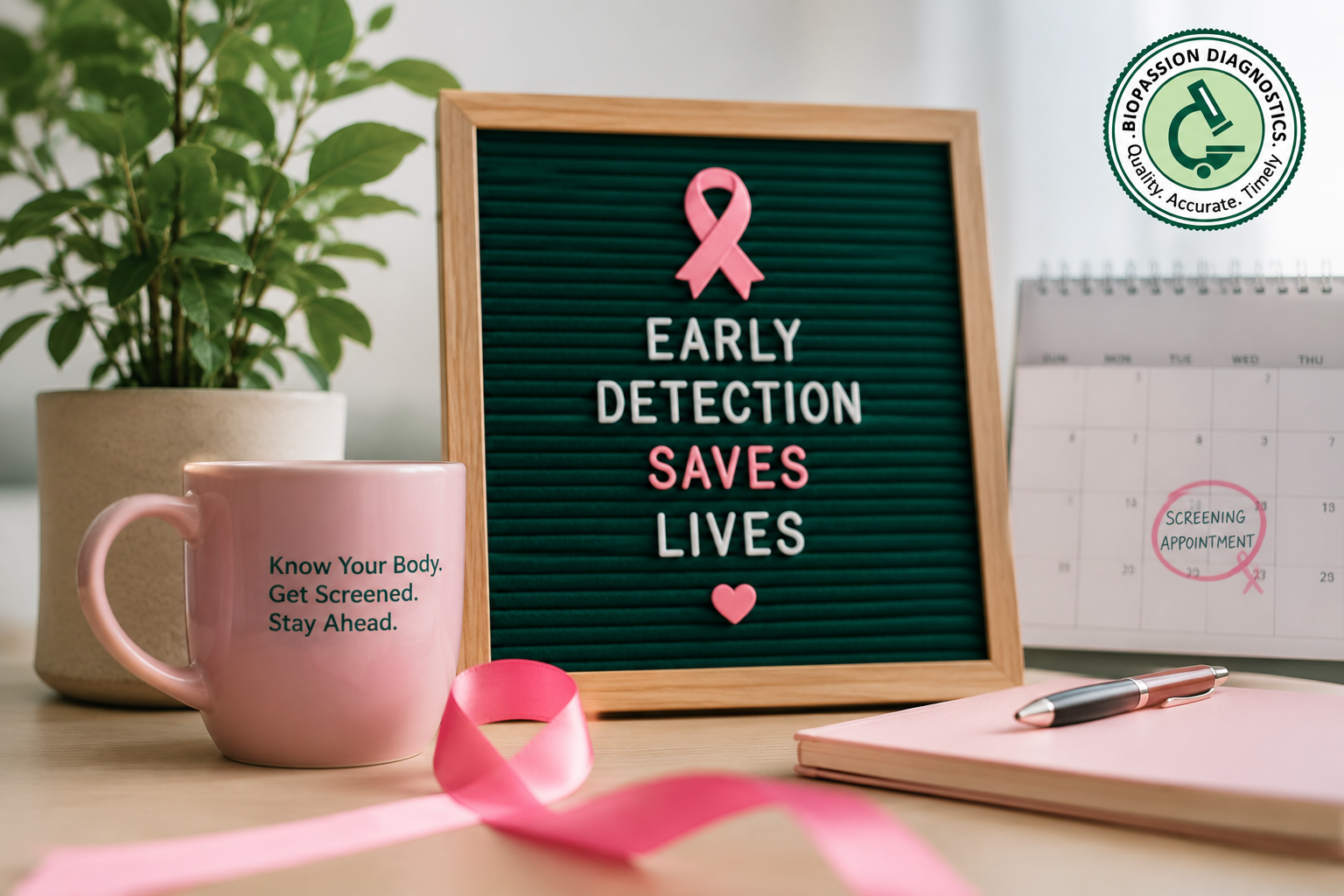
The data is unambiguous. Early detection saves lives. The only question left is whether we act on what we already know.
Have the conversation. Know your body. Five minutes today could buy you fifty years.
Don’t wait for a symptom to start paying attention.
Early detection isn’t complicated, it’s a conversation, a schedule, and a habit. Talk to a healthcare provider today about a screening plan that’s right for you.
Book your genetic cancer test.